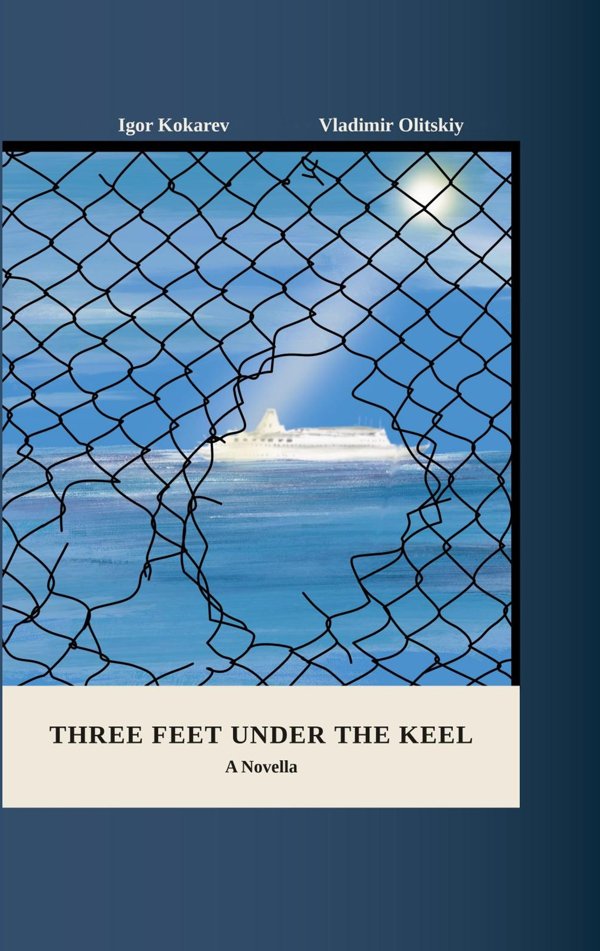
Three Feet Under the Keel
A novella
Igor Kokarev, Vladimir Olitskiy
Cover and drawings: Anna Pastushenko
Svoya Kniga Press, 2026
Here are the prologue and the first three chapters, free. The whole e-book is $4.99.
The cat Houston goes to sea (in Russian)
Prologue
Cap d'Antibes, Cannes, spring 1996. Vasily had been dragged here to gawk at movie stars by a cameraman he knew from the Odesa film studio. Well, he gawked. One morning he was standing on the waterfront, looking over the luxury yachts.
One caught his eye. She was moored almost next to him. White, huge, deck upon deck. A gangway ran from the shore to her wide stern. Come right on board, dear friend, as it were.
But that wasn't what hooked him. It was a heavyset man sitting in an armchair under an awning on the upper deck. Tanned, gray-haired and somehow familiar. Beside him another man, bent close to his ear. Then the man raised his hand, and a ring gleamed on his finger. Gold, heavy, dulled.
“The Boss!” Vasily recognized him now. Though he had seen him only once. But that was why he was the “Polyglot,” as the captain had called him in the old days: the sharp-eyed cruise director with the long memory on the glorious Assol.
Nikolay Petrovich! NP, as he was marked in that black folder. Or “the Boss,” as those who knew him called him… So this is where he was! And his own people had been looking for him for many years after the Assol, by his evil will, lost her beloved captain. By the same will her loyal crew was broken up. Some were written off the ship, some even fired from the shipping company, some were stripped of their “semaphore,” the seaman's foreign passport, and the rest were scattered over other ships.
That was when Vasily went ashore, too. He said goodbye to the fleet for good, worked as a translator in a design bureau, and remembered the star years of his life with pain.
Then the Soviet Union fell apart. On the Assol the Soviet flag was replaced with the Ukrainian one, and the glorious Black Sea fleet, cargo and passengers alike, was sold off ship by ship by those who lined their pockets using their official positions. That's how they became millionaires and crawled off all over the big wide world. One of them was on a hundred-meter yacht in Cannes.
There he was, the bastard, right before his eyes.
Vasily stood there, stunned.
He came home to Odesa a different man. That same evening he climbed up to the storage shelf and took down an old box. He untied it. On top lay the photos, the very ones from the Assol. He laid them out on the table, one by one, the way he had laid them out long ago, right after the captain's death. Some things have no statute of limitations.
Chapter 1The North. On the Bridge
The White Sea. February. In the wheelhouse of the old coastal bulk carrier Kigilyakh it is as cold as in an iron box. The calendar in the captain's cramped cabin shows the date: November 1986.
It was there that the news found him about the terrible disaster in Tsemes Bay on the Black Sea, where on August 31, 1986, two ships collided: a cargo ship and the passenger liner Admiral Nakhimov. Holed, the old tub rolled onto her side in eight minutes and went to the bottom, taking 423 lives with her.
Anikin, whose captain's rank had just been restored, could find no peace. He thought it over and plotted both ships' courses in his head. He understood better than anyone. He could feel, almost physically, that both were to blame. And he suffered unbearably, picturing the deaths of the passengers who had gathered for a nice vacation. Shaken, he wrote in his diary then: If you can't do it, don't take it on. And if you make a mistake, shoot yourself! Honor above all. He should have gone down with the ship. On the captain's bridge! Lord, how shameful…
Such were his notions of the honor and dignity of real captains, the very ones the shipping company's Party leadership was driving out at that time with idiotic persistence.
Master mariner, the celebrated Master Anikin, the pride and legend of Odesa, has spent five years in Tiksi Bay hauling firewood and crushed stone for the polar station crews instead of well-dressed passengers.
Noticeably sterner, having lost the romantic look of a sea wolf that women on both sides of the ocean had admired, the best captain on the American cruise lines, Vadim Anikin, stood in the cramped wheelhouse behind the helmsman and said nothing. He had been silent for years now. With hard creases above his tightly pressed lips, in a black uniform jacket with captain's stripes and a peaked cap with a long visor pulled down to his very brows, he stubbornly carried on with his work at sea.
His radiant smile was gone. His thick hair had gone gray under the same old peaked cap with its long visor over the sharp gaze of his gray eyes. Beyond the glass, the polar night, the Northern Lights over the Barents Sea, the pack ice the ship was forcing its way through; the snow blowing slantwise. Out of habit he fingered his prayer beads. One at a time, without looking. An old habit.
What was he thinking about? Probably still about her. About the Assol, which without him was still plowing the waters of the world's oceans, somewhere far away. Without him? How was that possible? Try as he might, he couldn't picture it. He wrote in his diary: Guys, how I miss you all!
To this day that song still rings in his ears, set to the tune of “Lieutenant Golitsyn,” with the words, “Don't lose heart, Master Anikin!…” His crew had sung it to see him off when he left the Assol in New Orleans in August 1981. It helps him hold on.
The Assol's crew had not forgotten him. Letters came. Olga Suvorova, who had known him since the first days of the ship's delivery, wrote and complained that she missed the old times. The bosun sent word from some cargo ship. Dobrodeychik was retired and very sick, but wrote, as always, with jokes worthy of Mikhail Zhvanetsky, Russia’s beloved satirist. His Lenka came to visit; like him, she was waiting for his return. Sometimes the letters said only: Don't lose heart, Master Anikin. He read them in his cramped cabin and did not lose heart.
Sometimes he took out a thick black notebook and, lost in thought, wrote something in it. He was talking to himself.
The helmsman on watch stood frozen at the wheel. Young, with chapped lips.
“Starboard five!” said the captain.
“Starboard five, aye!”
The ice scraped along the hull like someone dragging a seashell across glass. Anikin had gotten used to the sound over three navigation seasons in the North. Footsteps behind him. Someone had come up into the wheelhouse. He turned around. The radio operator was holding a telegram.
“A government one, Vadim Nikolayevich!” he said, handing it over with a smile.
The Master had been waiting for it all these years. Pride would not let him write complaints or ask anyone for patronage. But an old friend kept his hopes up. The one who still worked at the Central Committee:
“Hang in there, old man, times are changing! It's Perestroika out there, glasnost, new thinking!”
Maybe something really was changing. He read and reread the cold, impersonal lines: The Party Control Committee of the Central Committee of the CPSU extends its apologies…
For a long time he turned the brief letter on the CPSU Central Committee letterhead over in his hands.
That night he couldn't sleep. He got up, sat down at the table, took out his diary, half filled with short phrases, thoughts. This one, too, flowed out in small slanting lines: Squelching in the greasy, rusty mud, the horses sink to their stirrups… Why did he remember that song Vysotsky had sung to him back in 1975?
His hand trembled, and he went on: “Looks like these damned five years are finally over! Five years of humiliation, waiting for justice. They sure took their time thinking it over, there in that Central Committee. Strange, no joy in my heart. There was pain, now there's emptiness.
What tomorrow?”
Soon after the government telegram came, a letter from the Odesa prosecutor's office too, in the mail he received at every port call.
That evening he sat in his cramped, dim cabin and sorted through his letters, where an old photo with Nikita Khrushchev hung, at a table piled with books and newspapers, and portraits of Gorbachev. Most of the letters, as always, were written in the same woman's handwriting with the same return address. He raised them to his face and breathed in their scent deeply. Lenka.
Then he opened this letter. It was an official apology from the Odesa transport prosecutor's office. For a long time he held the official letterhead before his eyes, with its text:
…apology for causing great moral harm…
That night these banal bureaucratic apologies from the Odesa prosecutor's office were cast in his diary into a few uplifting lines, with hope hiding in them: “Well, now the shipping company should come to its senses too. It's their turn to give me back my Assol. Only who of my people is still there? Never mind, I'll bring everyone back! But this time, goddammit, no pompolit. What the hell do we need him for? We'll manage.”
* * *
Odesa, June of ’59. Primorsky Boulevard, a summer night, graduation at OVIMU. Almost thirty years ago. The cadets walk arm in arm toward the Duke de Richelieu Monument, with girls, with wine and songs. Someone is already pulling a striped sailor's shirt over the bronze head of the statue. Vadim, of course. Down below they laugh. That's the tradition. It smells of the sea, acacia and adventure.
Tall, broad-shouldered; his peaked cap pulled low over his brows. He didn't know himself where it came from in him. Since childhood the sea had pulled at him, the way others are pulled to the fields or the factory bench. Not a single sailor in the family. And still it pulled at him. Gumilyov was his favorite poet:
And all who dare,
Who want, who seek,
Who are sick of their fathers' lands…
And then Vadim saw her. A teenage girl is looking up at him from below and not laughing. Just looking. Their eyes meet, and everything around them freezes for a moment. The sea and the port flicker somewhere below the Potemkin Stairs with yellow lights. He jumped down and asked his girlfriend, without taking his eyes off the girl:
“Who's that?”
“Oh, she's from our courtyard. An eighth-grader. She tagged along after me: ‘Take me to the party, take me!’ I told her: ‘March home.’ She didn't listen.”
He remembered that turn of her head all his life. Though back then, of course, he didn't know he would remember it. The girl walks off into the shadow of the acacias.
And turns around again.
* * *
The Master is on the bridge again. He is in a white uniform jacket, in the same old peaked cap. This is now the passenger liner Maria Yermolova. The Murmansk Shipping Company. His Party card is back in his pocket; even his visa is open. The recent verdict of the Moscow cardiology center, “heart surgery required,” he brushed aside, afraid of losing time. He had bold plans he could not give up.
An entry in the diary that no one will ever read now:
They thought they'd finish me off in the North. Pathetic fools. I became an Arctic captain and came up with a cruise they never dreamed of. Just announce a voyage to the North Pole, and on a nuclear icebreaker at that, and the whole world will line up. I've already made a deal with her captain, Andrey Smirnov, a great guy, one of our kind.
An unbreakable spirit kept him going. His heart did not. Back then, after the trial, came the first warning: a hypertensive crisis, the hospital, the doctors' warnings: you must not go to the North! And where can I go?
He went ahead and went to the North.
On the calendar on the bulkhead behind him, 1991.
Here on the Maria Yermolova it's the same luxury, the same holiday for the passengers; only everything is strange to him. His crew is gone, his friends and comrades are gone, the ones who believed in him, and together they did their work in style. The Assol is somewhere nearby right now, in Germany, under scheduled repairs. And in Moscow there are mass demonstrations for freedom and democracy. The Party nomenklatura is fighting Perestroika. Only half a year is left until the end of the mighty empire.
But the Master doesn't know this. As always, he went about his seafaring duties conscientiously and with quiet dedication and passion. But here is the trouble. Deep down he is still waiting to return home, to Odesa. He believes in the final triumph of justice and demands that they give him back his Assol. How many times, swallowing his pride, he has turned with this request to the Black Sea Shipping Company administration.
Today, from a stack of birthday telegrams that have come to him here in Arkhangelsk, he pulls out one, the long-awaited one. In it, over the signature of the head of the Black Sea Shipping Company, V. V. Pilipenko, the terrible lines jump before his eyes:
Return to the Black Sea Shipping Company DENIED for the second time.
He felt a tightness in his left arm, near the shoulder. The prayer beads fell from his hands. And there was pain under his ribs. He wanted to breathe in and couldn't. The air stood still, like water in a hold. The last thing he saw was the portrait of Khrushchev shaking his hand…
* * *
Vasily, nicknamed “the Polyglot,” a name the Master had given him in those glorious years, learned of the death three days later. From a telegram with no return address, short as a slap in the face:
Vadim Nikolayevich Anikin has died. A heart attack. On the captain’s bridge.
And that was all.
He sat in the kitchen, in Odesa, and stared at those letters. Outside the window, a tram rustled along the tracks, heading, as always, to the same distant destination – 16th Station of Bolshoy Fontan, far beyond the city. The neighbor downstairs was frying zucchini, and the smell hit him deep in the gut. Life went on. It didn't care.
His heart. Oh sure. Tell those fairy tales to somebody else. Who better than him to know what had happened on the bridge?
And a week later a letter came. The captain had sent it right before departure, apparently having made some decision. Anikin wrote to Vasily briefly, as to someone who had always understood him without many words.
Year after year he had tried to understand why. Was the revenge of the pompolit, the ship's political officer, the only reason? It turned out it wasn't. He wrote that he had gotten close to a big criminal case.
It's all in the black folder, in the notebook, the letter said. But just where the folder was, it didn't say. He wrote: I'll fly in and show you. He didn't make it. People said that after his death some men searched his whole cabin, looking for something. They searched the cabin, and the safe, and the wheelhouse. And they found nothing – except for the unfinished manuscript of his book, Assol's Kitchen: Recipes and the Art of Service. And casually, almost as an afterthought, they asked: had anyone seen a black folder?
Who was looking? Why look for some folder when all the ship's papers were in place? Right where they were supposed to be. There was no autopsy. There was a search. Heart attack, that's what was written down. They didn't find the folder. Vasily put it together in his head, one thing to another.
He took down from the storage shelf a box that had once held Finnish cookies. Inside, tied with string, lay the old photographs from the Assol. He peered into the familiar faces as if waiting for some insight, an answer to the main question.
What now? Whom to look for? And where is that damned black folder?
From the photographs the cheerful eyes of his comrades looked back at him.
Chapter 2The Photograph
They were sitting on the rocks at Arkadia beach, a bit away from the sand beach packed with out-of-towners and tourists. Below, a wave slapped against the rocks, lazy and homey. The sun was setting slowly, going down behind the hills. The tankers in the roadstead stood motionless, as if glued to the horizon. Two friends sat there, looking over their new “crusts,” their captain's diplomas.
“Tell me, Captain, what distant horizons do you see?” Valery Kachura asked with a teasing smile.
“Far, Valery. I don't want to slave away on tankers and bulk carriers year after year all my life. I want freedom. I want to see the world—more than just oil terminals. I want people around me, all kinds of people, full of life. I want life to feel like a celebration. Hellish work, yes, but a holiday too, at different latitudes. Not for me, for people who will live their whole lives on shore in their villages. And the world is big, oh, how big and beautiful it is. Just imagine. Well, remember, at our summer training? I saw bored passengers and thought: give me this ship, and I'll show them the sea and the world —real adventures—so they'll remember it all their lives.”
Kachura grinned:
“I get it, the romance of the age of sail has got you by the collar:
On polar seas and southern seas,
Along the curves of the green swells,
Between basalt cliffs and pearly ones,
The sails of ships are rustling.”
He recited in his theatrical bass the immortal Gumilyov, read and reread at the amateur art evenings of their dear old marine school.
Vadim grinned and went on:
“The swift-winged ships are led by captains,
Discoverers of new lands,
Who have no fear of hurricanes,
Who have known maelstroms and shoals…”
He said it thoughtfully, gazing somewhere into the distance.
The Assol was still a long way off, sixteen years. The bridge of the Maria Yermolova, thirty-two.
For four years after that talk on Arkadia’s rocks he would plow the Black Sea on cruises from Odesa to Batumi and back, taking a close look at people, learning what made the Soviet tourist tick, who left half the price of his ticket to the one-armed bandits, and went ashore with shiny door handles he had unscrewed and rolls of toilet paper.
The small cruise liners of the Crimea–Caucasus line breathed a lust for cheap adventure, lounging in deck chairs, nightlife in the bars, free dancing and cheerful debauchery. The young captain learned to run this nonstop party, to see everything, remember everything; but he knew how to keep a good distance from temptation.
The crew loved him. For his restrained strictness, his respect for a person whoever he was, they called him very soon “Papa” behind his back. There he picked the crew with a view to working together in the future. People followed him, like the young third mate, Vladimir Vorobey, who would come with him to the Assol and grow into a captain, inheriting the best traditions of seamanship from “Papa.”
In ’64, after delivery in Germany at the shipyards of Warnemünde, fresh off the slipway, the cozy Bashkiria stood in Ventspils for a whole month, getting ready for a government voyage to Scandinavia. Partitions in the brand-new superstructures were torn down, the radio room was enlarged, the deluxe cabins, still smelling of fresh paint, were made bigger. Meanwhile the sailors enjoyed being close to their wives, who had flown in from Odesa to see their husbands and, while at it, to grab some foreign purchases. Vadim had recently married himself, not yet understanding that his fate was not family, but the sea.
Soon the Bashkiria, rebuilt while still brand-new, was getting ready to depart from the port of Leningrad. For the Sake of Peace was written on a banner stretched over the pier. A band played, speeches were made, and, in the crowd assembled for the occasion, the sailors' families stood out, standing at the very edge of the pier, waving handkerchiefs and little flags.
In reply, those whom Anikin had until then only seen in portraits waved politely: members of the Politburo, secretaries of the Central Committee. And Nikita Sergeyevich himself—round, bald, in a hat, pleased as a birthday boy.
Anikin is chief mate. Young, only twenty-eight, and already chief mate on a brand-new liner. When they put to sea, the curious Khrushchev suddenly came up to the bridge. He liked mingling with ordinary people. And he had to touch everything with his own hands.
“And what's this? And this?” he poked his finger at the instruments.
Anikin explained: about the engine, about the telegraph, about how the ship answers the helm. He spoke simply, without fawning, as if to a neighbor from the courtyard. Khrushchev liked that. Right away a TASS photographer started bustling about, lining everyone up for the newspaper. He put Anikin, a handsome man in a peaked cap pulled down to his brows—which suited him—next to the First Secretary. Khrushchev turned to him, condescending, like the master of the house:
“Well, Captain? Happy? Lucky you, standing next to the First Secretary. What more could you want in this life?”
“I'm not a captain yet, Nikita Sergeyevich. Chief mate. Standing with you, sure. I won't hide it. As for wanting…”
He thought for a second and said, looking him straight in the eye:
“I want a lot. But to put it short, to serve the Motherland. If only they wouldn't get in the way.”
“Get in the way? Who?” Khrushchev said it almost threateningly. “Here's my hand, Captain. Show this picture to anyone who gets in your way. You have my permission.”
And they shook hands. Firmly. A flash. A click. The photo was later printed in the newspapers and enlarged for him separately. Anikin put it in a frame and carried it with him all over the world. Not to show off. He simply believed, being young, that if the First Secretary himself had shaken your hand and said, “You can do it,” then the world was set up right; that everything would work out for him. It was no accident the ship was being readied for distant Western cruises, to earn hard currency for the country.
The chief mate was capable and quick-witted. And he already had some experience under his belt, such as it was. He had learned to feel his crew, and the ship entrusted to him, with all her machinery, was an extension of himself. He loved that feeling in himself and trusted it. He is the one Michael Zhvanetsky, famous writer, would one day describe: “Born free… Born handsome… Born a man.”
Years will pass. Khrushchev will be removed, and the Thaw will be forgotten even before he, Anikin, becomes captain of the Assol and puts his whole unbending soul into her. Those who send Khrushchev into retirement, the unsinkable CPSU and its greedy hangers-on, will tighten the screws again. And in the shipping company they will grind him down for his independence and for acting on his own outside the bounds of the instructions.
And then that photo with Khrushchev won't help. On the contrary, they'll hold that against him too: put away your letter of protection; his time is over.
But that's later. And back then, on the bridge of the Bashkiria, under the mild Scandinavian sun, chief mate Anikin held in his palm the hand of a man who ruled a sixth of the world's land, and believed his every word.
And he was happy. Truly happy.
Chapter 3The Die Is Cast
Assol became the ultimate test of his life—his destiny, his reward, and his punishment. But let’s take things in order.
This Western cruise liner, designed by the Danes and built at a British shipyard, was a luxury ship for its time. The USSR bought it specially for the hard-currency tourist market, for American routes in the Caribbean. A bold step into the unknown.
And so the first candidate for captain was summoned before the bureau of the regional Party committee. In those days that was where such appointments were approved, not at the Black Sea Shipping Company.
Some fifteen bureau members from the Party nomenklatura sat at a T-shaped table and listened to the objections of one of their number. A man from the KGB. What he said came down to this: the mission needed a more experienced captain, one the Party had tested better. Many of the members, directors of Odesa factories, heads of research institutes, and the obligatory milkmaid from the local collective farm, backed him. And the captain stood before them like a schoolboy.
But the First Secretary summed up unexpectedly:
“Comrades, Vadim Nikolayevich Anikin is recommended by Moscow, by the Central Committee of the CPSU. Any objections?”
Strangely enough, there were none. Even the gloomy KGB man shrugged:
“Well, if the Central Committee recommends him…”
And he gave the captain an icy look. Anikin remembered that “if it recommends him.” He knew: the blow would come later.
The First Secretary saw him off in the corridor with a parting word:
“Comrade Anikin, listen to me. The main thing is, don’t corrupt the crew with Western luxury. Consumer psychology is sticky stuff. You’ll have close to three hundred sailors on board and over five hundred American tourists, who are basically the antipodes of Soviet power. There may be provocations.”
“If you’re scared of wolves, stay out of the woods,” Vadim said with a confident smile. “I’ll pick the crew myself. And we won’t hide from them like lepers. We’ll be number one on those routes. That I promise you. Permission to go?”
Permission granted.
And he went off to put together a crew that was destined to become the best. It couldn’t be otherwise, he said, looking at Khrushchev’s framed photograph on his table.
He started with the girls. At Odesa Vocational School he walked the corridors and looked over the flocks of future waitresses and stewardesses the way a man looks over brides.
“I need the prettiest, the smartest, the most talented,” he told the director. “Girls who can sing and dance, and whom everyone will like.”
He gathered them in a lecture hall and spoke plainly:
“Girls, a sweet life and a dog’s work are waiting for you. No, first the dog’s work. You’ll live by Western standards, so you’ll work by them too. Work like horses. Look like actresses. We’ll be the best, and I won’t treat anyone unfairly. Whoever is ready to serve the Motherland that way, raise your hand.”
Hands shot up all over the room, like smoke rising in a column.
The one who had brought this flock to his meeting was the school’s young head of studies. Blue eyes, wide open, like doors to the sky. He had seen those eyes once before, long ago, looking down at them, in the shade of the acacias. By the Duke de Richelieu Monument that night, when the cadets were out celebrating their graduation. She was a teenage girl then. Now she was a beauty, her hair still cut short, and she looked at him, and did not look away.
“And who is that?” he asked the director, saying goodbye after the meeting.
“Our head of studies? A good worker. Levchenko. Yelena. Only please don’t take her from us. We’d be orphans.”
He nodded with a strange smile in reply. Something inside him said: I’ll take her, all right. If she wants. After all, so many years have passed. Could she remember too? Or had she never forgotten?
Then Vadim recruited a soccer team. At the stadium in Odesa Shevchenko Park he talked a coach he knew for years into giving him three strong boys. He asked these boys straight out:
“Who wants to be a sailor? I’ll take you without a diploma and train you as an able seaman myself.”
“What does a ship need a soccer player for? You can’t even kick a ball properly there,” the coach said, surprised.
“So they have something to do when they’re off watch. They’ll teach the others, and the Assol will have a real soccer team,” the captain said. “And in foreign ports they can take on the locals. Defend the Motherland’s honor. And you couldn’t ask for better publicity.”
“You’re a sly one, Vadim,” the coach said, surprised. “Well, all right, if they agree, I don’t mind.”
And the interpreter required by the staff list he found purely by chance. On the pier by the Adzharia a young border-guard lieutenant he didn’t know stopped him and wouldn’t let him onto his own ship: the border was closed, inspection under way. The captain didn’t argue. He only asked:
“What school did you finish, Lieutenant?”
“The Maurice Thorez Institute. Interpreter in English and Spanish.”
“And what’s your name, Maurice Thorez?”
“Vasily, Comrade Captain.”
“Listen here, Vasily. In April the Assol comes out of dock. Will you come with me as interpreter and administrator on the American routes?”
The border guard was taken aback:
“Yes, Comrade Captain. If you’ll take me.”
That is how the Polyglot turned up on the Assol. In time he would become the cruise director and one of the people closest to the captain on board.
There was one man he could not choose: the pompolit. At the personnel department he asked honestly:
“Give me a decent one. One who won’t scare people and won’t get in my way.”
The personnel man spread his hands:
“We don’t handle those cadres, Vadim. You know who does.”
And he slipped him a personnel file. Anikin only winced at the time: a pig in a poke. And probably wearing shoulder boards.
Gunyaev V.P., former political worker in the Soviet Army, never smelled the sea, but has decorations.
This is the beginning of the book. Eighteen more chapters follow: what happened to Captain Anikin and his Assol.
Hardcover: printed to order and shipped by Lulu.
E-book (EPUB): reads on a phone, tablet, computer or e-reader. It arrives by email right after payment.
Reading version for the website. The characters' names have been changed.
Back to top